I love these cards. I feel that Michael Goepferd had no idea just how much he had accomplished with this beautiful deck before he passed. Brian Williams, historian, artist, and tarot deck creator certainly knew, as is conveyed in his sensitive text in the book that accompanies the deck. The book is written in equally artistic prose, which is a tribute to the fabulous linoleum blockprint cards.
The process of creating art via linoleum block prints necessitates the ability to see negative space as well as positive space. This use of positive/negative space makes the deck very effective for doing shadow work. Another thing that makes this deck especially suited for such work is its beautifully neutral "tone". This is not a deck like Medicine Woman (reviewed later in this series), which is affirmative to the point of dispensing only hugs, nor is it like the Thoth deck, which tends to hit one up beside the head more often than not. This is not a criticism of either of the decks mentioned above, as I use them both; but for shadow work, the pure neutrality of a deck that offers a clear and equal look at both light and shadow is the ideal choice. The elimination of color is a third mechanism for facilitating such studies. The reader now sees reality reduced to simple black and white, with no distractions.
The word "Shadow", used here to mean a psychological construct, was introduced by Carl Jung. Simply put, the shadow is all the baggage we carry around and refuse to look at, for fear of what we might see. The unfortunate thing is that refusal to acknowledge and deal with shadows is what makes them become increasingly more terrifying and crippling. Shadow work allows the individual to bring those shadows into the light for examination and release. Such a release, though possibly attained with some pain, leads to intense empowerment.
Notice the small, huddled dark figure on the back of the character in the Ten of Wands. This is a great illustration of the conceptual shadow self, which not surprisingly is out of the man's vision, yet adding to his load. The man is carrying far more than mere wands and ridding himself of that shadow burden would make the wands much easier to handle.
Whether Goepferd realized the potential of his art and this medium as a way to access the shadow self or not, his deck is very powerful for such purposes.
The Shaman must be able to see her own Shadow self in all of its manifestations. Only by recognition of these shadows, and by their subsequent acknowledgement, clearing, and healing, can the Shaman move on to heal herself and those who seek her out. I use this deck constantly in my daily work. It never lies to me.... and it never fails to show me where I need to do further work.
Review by Valerie Sim-Behi
http://www.tarotpassages.com/lightshadowvsb.htm


Writing is rewriting
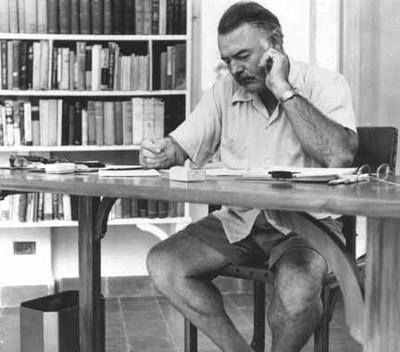
Ernest Hemingway once confided to George Plimpton during an interview that he rewrote the ending to "A Farewell to Arms" 39 times before he was satisfied.
Why so many rewrites? Plimpton asked.
Because, Hemingway responded, he wanted to get the words right.
Would that newspapers had more Hemingways. We ink-stained wretches can't rewrite every story ending 39 times and still make deadline. But for many of us, a single rewrite would be a giant leap forward, making our newspapers measurably better.
Ask any copy editor or line editor: Revision is easily the most neglected part of the writing process. Whether it's through laziness, hurriedness or the stigma of revision as scut work, far too many of us leave excess baggage in our stories for others to cull.
That's because many writers file not stories, but drafts. They think their first try is their last try, or that their first try, checked for style, spelling and grammar, makes for a complete story. In rare deadline situations, it may. But by and large, such an attitude is folly because it subjects the draft to the writer's needs (clean it up, get it out), not the reader's (clarity and understanding).
And then there's the old newspaper stereotype: Good writers get it right the first time. You're supposed to produce perfection, or at least near-perfection, on the first draft. That's the sort of B.S. that makes writers sweat every word or phrase as they go, putting all their mental energy into revising rather than creating by writing freely. It produces weak stories. In truth, you can't draft and polish at the same time. You might as well try waxing your car while you're hosing off the dirt.
The best writers have learned what Hemingway knew: Writing is rewriting. It's where the story truly takes shape, where the writer marshals just the right words, a fitting image, a phrase turned just so. Everything beforehand is a warm-up.
The best writers don't spit out a draft and fly home. They stay a while and polish the rough diamond. Even on a tedious story, they'll do one thing that's uniquely theirs, even if it's a simple as a well-chosen verb.
That means they search their draft with a critical eye for the nuggets of meaning and power, using the draft's strengths to form a finished story that readers will want to read, that's clear, simple, focused and understandable.
They ask themselves: What works? What needs work? What's there? What's missing?
from the web
------- Could the stories you tell others about yourself ,and the stories you tell yourself about you, need a rewrite? Are they truly your stories, in your voice, written with your words, just the right words, true to your life story as you feel it should be told? Related posts: Resistances To Loving Ourselves; Narrative Therapy. ---------
Memories return now & then

The White House at Night - June 1890 (Auvers);
Oil on canvas, 59 x 72.5 cm (23 1/4 x 28 1/2")
Gogh, Vincent (Willem) van (b. March 30, 1853, Zundert, Neth.--d. July 29, 1890, Auvers-sur-Oise, France)
Gogh, Vincent (Willem) van (b. March 30, 1853, Zundert, Neth.--d. July 29, 1890, Auvers-sur-Oise, France)
.
After Many Years Absent
Single bits of many houses clumped together
green shingled eves, a patched chimney
cracked, layered slate roofing, and attic dormers
Single bits of many houses clumped together
green shingled eves, a patched chimney
cracked, layered slate roofing, and attic dormers
the pale sky almost violet, fading in
this between hour after dinner and before bedtime
remembering
I have spent the day inside this house, alone
going through the rooms one floor at a time
lumbering methodically trying
this between hour after dinner and before bedtime
remembering
I have spent the day inside this house, alone
going through the rooms one floor at a time
lumbering methodically trying
to put all that has been moved or removed
back where it was before I left
before I knew I would ever leave
before I knew I would have to leave
Not much has changed. Only a few things
Time changes
I do not remember my crib even now
that I see it stowed in the attic next to Gramma’s
steamer trunk where Christmas ornaments packed
in old egg cartons and tissue paper
have been kept since she died in 1968.
The painted animals on the crib are worn
barely recognizable scant remains of a blue elephant
and the hingquaters of a zebra;
the whole of it covered in dust.
Do I remember my highchair? my potty? the yellow bear?
The yellow bear on the potty! Ballons tethered to his overalls
fallen down around fuzzy ankles, balloons red yellow blue & green.
I am sure I loved that bear.
I crouch down low below splintered raw beams
the dry air challenging my lungs. Light slips through
torn parts of the yellow browned parchment shade
nailed to the window frame and sill; worn, musty
holding secrets inside trapped away from the scorching sun
beating against the high dormer pane.
They told me over supper last night that I used to pinch Gramma’s legs
they say, to see her skin turn black and purple.
before I knew I would have to leave
Not much has changed. Only a few things
Time changes
I do not remember my crib even now
that I see it stowed in the attic next to Gramma’s
steamer trunk where Christmas ornaments packed
in old egg cartons and tissue paper
have been kept since she died in 1968.
The painted animals on the crib are worn
barely recognizable scant remains of a blue elephant
and the hingquaters of a zebra;
the whole of it covered in dust.
Do I remember my highchair? my potty? the yellow bear?
The yellow bear on the potty! Ballons tethered to his overalls
fallen down around fuzzy ankles, balloons red yellow blue & green.
I am sure I loved that bear.
I crouch down low below splintered raw beams
the dry air challenging my lungs. Light slips through
torn parts of the yellow browned parchment shade
nailed to the window frame and sill; worn, musty
holding secrets inside trapped away from the scorching sun
beating against the high dormer pane.
They told me over supper last night that I used to pinch Gramma’s legs
they say, to see her skin turn black and purple.
I remember liking Gramma Lillian. Lillian Marie.
She died when I was four and they did not let me go to her funeral.
I was too young for death, they said, and sent me to Mrs. Murphy.
I do remember
Gramma’s stockinged legs plump cushions from my head,
those big black nun shoes, and the finely stiched hem of paisley dresses
purple blue and dark maroon. I wrapped my arms around her legs
and squeezed tightly, sometimes afraid, sometimes rocking and giggling
safe from the harsh voices above. She never minded
I was too young for death, they said, and sent me to Mrs. Murphy.
I do remember
Gramma’s stockinged legs plump cushions from my head,
those big black nun shoes, and the finely stiched hem of paisley dresses
purple blue and dark maroon. I wrapped my arms around her legs
and squeezed tightly, sometimes afraid, sometimes rocking and giggling
safe from the harsh voices above. She never minded
often stroked my hair gently. Yes, Gramma, I remember – Lillian Marie.
Warm afternoon after Thanksgiving meal
Warm afternoon after Thanksgiving meal
sitting in the bay window with my toy box.
Outside a bird, a robin perched on the icy gate swung open,
crushed against the trellis where honeysuckle climbs in Spring
flower to lick sweet and birdy looks hungry.
Why are you crying, little man? Come here. What are you looking at?
Why are you crying, little man? Come here. What are you looking at?
The birdie? Why won’t you stop crying? You have all your nice toys.”
A man said, “Leave him be. Kids cry. That’s what they do.
You spoil them if you pick them up every time they cry.”
The door between the kitchen and dining room swings open;
The door between the kitchen and dining room swings open;
“I’ll be finished soon then he’ll have his nap. You two go relax.”
The gate was supposed to be closed, not smashed up against the vine.
Someone should close the gate!
The honeysuckle will be smashed and broken
there will be no sweet in Spring
she will be furious if someone doesn’t close the gate
“Fly away birdie! Fly away!” I scream.
I look out over Maplewood through the torn shade
Catholic churches and the bulky industry of the forties
stand where once vast groves of maple pine poplar & cherry grew.
The rust colored leaves of McMullin’s sappy maple loose their grip
on the parched branches waiting for rain
beyond Albemarle & Clay streets further out away
down Dewey Avenue the structures diminish into flatland
ending at the shore of Lake Ontario. One steel smokestack
at Kopdak Park on Ridge Road snatches the last glint of the sinking sun
The gate was supposed to be closed, not smashed up against the vine.
Someone should close the gate!
The honeysuckle will be smashed and broken
there will be no sweet in Spring
she will be furious if someone doesn’t close the gate
“Fly away birdie! Fly away!” I scream.
I look out over Maplewood through the torn shade
Catholic churches and the bulky industry of the forties
stand where once vast groves of maple pine poplar & cherry grew.
The rust colored leaves of McMullin’s sappy maple loose their grip
on the parched branches waiting for rain
beyond Albemarle & Clay streets further out away
down Dewey Avenue the structures diminish into flatland
ending at the shore of Lake Ontario. One steel smokestack
at Kopdak Park on Ridge Road snatches the last glint of the sinking sun
vomits white steam hot cold joining as darkness approaches,
again.
.
from After Many Years Absent & Other Poems - M. Hannan © 1993
Modern Mystical Movement
Copyright Hank Wesselman, 2002.
It is no news to anyone in the Western World that increasing numbers of people are leaving our mainstream religions in droves.
What is news is that this is not an atheistic movement. Quite the contrary. A wide-spread spiritual reawakening is taking place--one that is cutting across socioeconomic levels of achievement and status, one that is transcending cultural, political, and ethnic boundaries as well.
This social movement is intensely democratic and appears to be made up of people who hold a set of beliefs and values that differ from those of the general public. This new belief complex is quietly, yet definitively, gaining acceptance among increasing numbers of well-informed and well-connected individuals, many of whom are in professional and social positions from which they can influence the larger society's ideas and trends.
The number of people involved is not known with certainty, but 14 years of social research in the United States by demographer Paul Ray, PhD., has shown that more than 50 million Americans may fall into this category, representing more than 25% of the adult population. This is not a small number, and it appears to be growing. Ray's analysis suggests that we Westerners have arrived at a point in our history in which our prevailing mythologies are not working so well any more. The 50 million among us know, without being told, that it is time to create a 'new story', a new cultural myth, in which we synthesize a whole new set of ways of seeing ourselves and our society, as well as our place in the greater scheme of things.
Ray's survey has revealed that the citizens involved are socially-concerned, environmentally-aware, and spiritually-focused creative people, who are carriers of more positive ideas and values than in any previous period of history. The ever-increasing numbers of these 'cultural-creatives' know with absolute certainty that if we continue to do business as usual, Western Civilization may well collapse, taking the rest of the world with it. This awareness is producing a growing sense of urgency, an existential angst, accompanied by an insistence on social, political, and economic reform that will benefit everyone, not just the powerful and the privileged.
Anthropologists might call this a new kind of cultural revitalization movement and observe that such a shift in the dominant cultural pattern of a society happens only once or twice in a thousand years. This one is occurring during a period of ever-accelerating social change, enabled by a high technology and a world-wide communication system unlike any ever seen before. This suggests that the shift has already spread far beyond the boundaries of the Western World, and may, in fact, be happening on a planetary scale.
Core beliefs:
1.The belief that everything and everyone is part of a pattern and thus interconnected.
2. The belief in the existence of an alternate reality, often referred to as the 'other world', the 'spirit world', the 'dreamtime', or simply, 'the sacred' by the traditional peoples. Modern mystics often refer to it as 'nonordinary reality'.
3.The belief in the ability of some individuals to achieve transcendent states of consciousness in which it becomes possible to enter into this alternate reality for problem-solving and the healing of self and others. This belief is usually accompanied by a strong desire to personally experience the alternate reality.
4. The belief in the existence of spirit helpers and spirit teachers who reside in the alternate reality.
5. The belief that everything, both living and inanimate, is imbued with its own personal supernatural essence or soul. This includes the certainty that everything everywhere is aware and thus 'minded' to some degree.
6. The belief in the existence of an impersonal supernatural power or vital force that is highly dispersed throughout the Universe, but which can be highly concentrated in certain places, objects, and living beings as life-force.
7. The belief in a personal energy body around and within which the physical body is formed. This energetic aspect can be perceived by those with psychic awareness as an aura, and modern mystics know that it can be enhanced through centers located within it--the chakras and meridians in Eastern thought.
Core Values
1. Modern mystics hold a strong concern for social justice and the quality of life at all levels of society, both nationally and internationally.
2. Social tolerance, individualism, and spiritual freedom are highly valued ideals.
3. Strong support is felt for women's issues as well as the safety and well-being of children and the elderly. The rebuilding of families, neighborhoods, and communities are seen as major areas of concern, and human relationships are perceived to be of more importance than material gain.
4. Spiritual, mental-emotional, and physical balance and harmony are seen as critical to the well-being of the individual, the family, the society, the business firm, the nation-state, and the planetary community as a whole. Accordingly, it is understood that humans must live their lives in ways that contribute to this balance, rather than following lifestyles or pursuing goals that create its opposite.
5. Modern mystics are environmentally savvy. The survival of the environment and by association, the human species, is number one on their list. They carry a deep respect for Nature and are seriously concerned with stopping corporate polluters, reversing greenhouse warming, and discovering the limits to short-term growth so that the world community can achieve the long-term ecological sustainability upon which the future of humanity depends.
6. Accordingly, the value of simple, natural living is seen as a high ideal.
7. Modern mystics tend to hold strong feelings of disaffection for Western allopathic medicine. These concerns are being greatly enhanced by the increasingly negative effects on the quality of healthcare being introduced by the business-oriented and profit-motivated Health Maintenance Organizations (HMOs).
8. While all are very much aware of Western Medicine's often miraculous achievements, most of us have strong interests in alternative and preventative healthcare modalities (holistic, shamanic, transpersonal, herbalist, acupuncture, ayurvedic, and meditative, to name only a few). These therapies are seen as 'adjuncts to' rather than as 'replacements for' Western Medicine.
9. No one today can deny that the world's social, political, economic, and religious problems are reaching critical mass. Modern mystics believe that the ultimate solutions to all our problems will be achieved through the current spiritual reawakening as it progresses from the personal to the global. They know that it has the potential to propel humanity into the next phase of its evolution as a more aware life form with more expanded abilities.
10. Finally, virtually all who hold these beliefs and values are seekers of the direct, transformative experience of transcendence, and it is really this that defines us as mystics.
In summation, modern mystics are engaged in intensive, personal quests for spirituality, meaning, and transcendence. Although most tend not to be affiliated with organized religions, most profess beliefs in some form of supernatural god-like being or consciousness, and Jesus of Nazareth is regarded as a spirit teacher of great power, whether or not the spiritual seeker is psychologically Christian.
The members of this growing social movement are searching for ways to organize their lives in a personally more satisfying manner. Paul Ray's study suggests that we should take hope, for we are traveling in the company of an enormous number of allies who are everywhere, in every community, and at every level of society, revealing that this steadily-escalating social phenomenon has all the appearances of a spiritual revolution.
Let the media, the politicians, the multinational corporations, and the social analysts take heed. The sheer number of people involved suggests that the modern mystical movement, of which the so-called New Age is a part, is not a fad. Rather, a true Transformational Community is emerging, one whose beliefs, values and trends are already in the process of shifting the cultural norms of Western Society.
The majority believe that the individuals involved in this movement are the 'seed people' who may determine the shape of the world's spiritual orientation and practice for much of the next 2000 years. If true, the history of the planet will be profoundly and inescapably changed by the spiritual resurgence going on in the Western world. The results will be felt at every level of society, in every country, and will, by association, determine much of the politics and individual lifeways of the 21st Century.
It is no news to anyone in the Western World that increasing numbers of people are leaving our mainstream religions in droves.
What is news is that this is not an atheistic movement. Quite the contrary. A wide-spread spiritual reawakening is taking place--one that is cutting across socioeconomic levels of achievement and status, one that is transcending cultural, political, and ethnic boundaries as well.
This social movement is intensely democratic and appears to be made up of people who hold a set of beliefs and values that differ from those of the general public. This new belief complex is quietly, yet definitively, gaining acceptance among increasing numbers of well-informed and well-connected individuals, many of whom are in professional and social positions from which they can influence the larger society's ideas and trends.
The number of people involved is not known with certainty, but 14 years of social research in the United States by demographer Paul Ray, PhD., has shown that more than 50 million Americans may fall into this category, representing more than 25% of the adult population. This is not a small number, and it appears to be growing. Ray's analysis suggests that we Westerners have arrived at a point in our history in which our prevailing mythologies are not working so well any more. The 50 million among us know, without being told, that it is time to create a 'new story', a new cultural myth, in which we synthesize a whole new set of ways of seeing ourselves and our society, as well as our place in the greater scheme of things.
Ray's survey has revealed that the citizens involved are socially-concerned, environmentally-aware, and spiritually-focused creative people, who are carriers of more positive ideas and values than in any previous period of history. The ever-increasing numbers of these 'cultural-creatives' know with absolute certainty that if we continue to do business as usual, Western Civilization may well collapse, taking the rest of the world with it. This awareness is producing a growing sense of urgency, an existential angst, accompanied by an insistence on social, political, and economic reform that will benefit everyone, not just the powerful and the privileged.
Anthropologists might call this a new kind of cultural revitalization movement and observe that such a shift in the dominant cultural pattern of a society happens only once or twice in a thousand years. This one is occurring during a period of ever-accelerating social change, enabled by a high technology and a world-wide communication system unlike any ever seen before. This suggests that the shift has already spread far beyond the boundaries of the Western World, and may, in fact, be happening on a planetary scale.
Core beliefs:
1.The belief that everything and everyone is part of a pattern and thus interconnected.
2. The belief in the existence of an alternate reality, often referred to as the 'other world', the 'spirit world', the 'dreamtime', or simply, 'the sacred' by the traditional peoples. Modern mystics often refer to it as 'nonordinary reality'.
3.The belief in the ability of some individuals to achieve transcendent states of consciousness in which it becomes possible to enter into this alternate reality for problem-solving and the healing of self and others. This belief is usually accompanied by a strong desire to personally experience the alternate reality.
4. The belief in the existence of spirit helpers and spirit teachers who reside in the alternate reality.
5. The belief that everything, both living and inanimate, is imbued with its own personal supernatural essence or soul. This includes the certainty that everything everywhere is aware and thus 'minded' to some degree.
6. The belief in the existence of an impersonal supernatural power or vital force that is highly dispersed throughout the Universe, but which can be highly concentrated in certain places, objects, and living beings as life-force.
7. The belief in a personal energy body around and within which the physical body is formed. This energetic aspect can be perceived by those with psychic awareness as an aura, and modern mystics know that it can be enhanced through centers located within it--the chakras and meridians in Eastern thought.
Core Values
1. Modern mystics hold a strong concern for social justice and the quality of life at all levels of society, both nationally and internationally.
2. Social tolerance, individualism, and spiritual freedom are highly valued ideals.
3. Strong support is felt for women's issues as well as the safety and well-being of children and the elderly. The rebuilding of families, neighborhoods, and communities are seen as major areas of concern, and human relationships are perceived to be of more importance than material gain.
4. Spiritual, mental-emotional, and physical balance and harmony are seen as critical to the well-being of the individual, the family, the society, the business firm, the nation-state, and the planetary community as a whole. Accordingly, it is understood that humans must live their lives in ways that contribute to this balance, rather than following lifestyles or pursuing goals that create its opposite.
5. Modern mystics are environmentally savvy. The survival of the environment and by association, the human species, is number one on their list. They carry a deep respect for Nature and are seriously concerned with stopping corporate polluters, reversing greenhouse warming, and discovering the limits to short-term growth so that the world community can achieve the long-term ecological sustainability upon which the future of humanity depends.
6. Accordingly, the value of simple, natural living is seen as a high ideal.
7. Modern mystics tend to hold strong feelings of disaffection for Western allopathic medicine. These concerns are being greatly enhanced by the increasingly negative effects on the quality of healthcare being introduced by the business-oriented and profit-motivated Health Maintenance Organizations (HMOs).
8. While all are very much aware of Western Medicine's often miraculous achievements, most of us have strong interests in alternative and preventative healthcare modalities (holistic, shamanic, transpersonal, herbalist, acupuncture, ayurvedic, and meditative, to name only a few). These therapies are seen as 'adjuncts to' rather than as 'replacements for' Western Medicine.
9. No one today can deny that the world's social, political, economic, and religious problems are reaching critical mass. Modern mystics believe that the ultimate solutions to all our problems will be achieved through the current spiritual reawakening as it progresses from the personal to the global. They know that it has the potential to propel humanity into the next phase of its evolution as a more aware life form with more expanded abilities.
10. Finally, virtually all who hold these beliefs and values are seekers of the direct, transformative experience of transcendence, and it is really this that defines us as mystics.
In summation, modern mystics are engaged in intensive, personal quests for spirituality, meaning, and transcendence. Although most tend not to be affiliated with organized religions, most profess beliefs in some form of supernatural god-like being or consciousness, and Jesus of Nazareth is regarded as a spirit teacher of great power, whether or not the spiritual seeker is psychologically Christian.
The members of this growing social movement are searching for ways to organize their lives in a personally more satisfying manner. Paul Ray's study suggests that we should take hope, for we are traveling in the company of an enormous number of allies who are everywhere, in every community, and at every level of society, revealing that this steadily-escalating social phenomenon has all the appearances of a spiritual revolution.
Let the media, the politicians, the multinational corporations, and the social analysts take heed. The sheer number of people involved suggests that the modern mystical movement, of which the so-called New Age is a part, is not a fad. Rather, a true Transformational Community is emerging, one whose beliefs, values and trends are already in the process of shifting the cultural norms of Western Society.
The majority believe that the individuals involved in this movement are the 'seed people' who may determine the shape of the world's spiritual orientation and practice for much of the next 2000 years. If true, the history of the planet will be profoundly and inescapably changed by the spiritual resurgence going on in the Western world. The results will be felt at every level of society, in every country, and will, by association, determine much of the politics and individual lifeways of the 21st Century.
Emotions: Basic, Primal, Immature, Unevolved?
Recently, a close friend of mine made the remark that our emotions for the most part are basic, primal, immature and unevolved.
Ever since then, I have been ruminating on the veracity of this statement. Like most "truths," this seems to be equally true and untrue -- and therefore, possibly a half truth. In nature's scheme, nothing is wasted. The universe is a big jigsaw puzzle where everything seems to fit.
According to Charles Darwin, nature favors emotionality as a feature of natural selection. And, natrual selection has only one intention -- survival. According to Darwin, fear readies the animal for flight in dangerous situations. Anger readies the animal for combat. Jealousy alerts the animal to the possibility of usurpation of reproductive chances, etc.
Anger by itself is not considered a toxic emotion. On the other hand, hostility is felt to be very toxic. Hostility occurs when there are resentments or grievances, and when there is an unconscious need for getting even, for vengence, or for retribution. Hostility is considered to be the number one risk factor for premature death from cardiovascular illness by epidemiologists.
The best way to handle toxic emotions is to become aware that not all emotional turbulence is necessarily toxic. Fear, hostility, guilt and depression are considered to be the most toxic emotions. Depression undermines the immune system and makes one more susceptible to cancer and infections, according to some psycho-neuroimmunoligists. Hostility and aggression predispose one to autoimme illness and cardiovascular accidents.
Psychologists tell us the best way to deal with these toxic emotions is to go through the following processes:
1. Take responsibility for your own emotions. If you are waiting for somebody else to change so you can feel better, you might wait for a long time.
2. Witness the emotion. All emotions are sensations in the body. Feel the sensations.
3. Define the emotions in an emotional vocabulary that does not represent victimization. Feeling sad, for example, is a genuine emotion. Feeling abandoned, on the other hand, represents victimization.
4. Express emotions by journaling, preferably in the first person, second person and third person.
5. Share your emotions with a close and trusted friend, or lover.
6. Release emotions, preferably through ritual practice.
7. Celebrate and move on.
If you feel that your emotions are basic, primal, immature and unevolved, remember what Charles Darwin said -- natural selection favors them as part of the evolutionary scheme.
by Deepak Chopra
http://www.intentblog.com/
Ever since then, I have been ruminating on the veracity of this statement. Like most "truths," this seems to be equally true and untrue -- and therefore, possibly a half truth. In nature's scheme, nothing is wasted. The universe is a big jigsaw puzzle where everything seems to fit.
According to Charles Darwin, nature favors emotionality as a feature of natural selection. And, natrual selection has only one intention -- survival. According to Darwin, fear readies the animal for flight in dangerous situations. Anger readies the animal for combat. Jealousy alerts the animal to the possibility of usurpation of reproductive chances, etc.
Anger by itself is not considered a toxic emotion. On the other hand, hostility is felt to be very toxic. Hostility occurs when there are resentments or grievances, and when there is an unconscious need for getting even, for vengence, or for retribution. Hostility is considered to be the number one risk factor for premature death from cardiovascular illness by epidemiologists.
The best way to handle toxic emotions is to become aware that not all emotional turbulence is necessarily toxic. Fear, hostility, guilt and depression are considered to be the most toxic emotions. Depression undermines the immune system and makes one more susceptible to cancer and infections, according to some psycho-neuroimmunoligists. Hostility and aggression predispose one to autoimme illness and cardiovascular accidents.
Psychologists tell us the best way to deal with these toxic emotions is to go through the following processes:
1. Take responsibility for your own emotions. If you are waiting for somebody else to change so you can feel better, you might wait for a long time.
2. Witness the emotion. All emotions are sensations in the body. Feel the sensations.
3. Define the emotions in an emotional vocabulary that does not represent victimization. Feeling sad, for example, is a genuine emotion. Feeling abandoned, on the other hand, represents victimization.
4. Express emotions by journaling, preferably in the first person, second person and third person.
5. Share your emotions with a close and trusted friend, or lover.
6. Release emotions, preferably through ritual practice.
7. Celebrate and move on.
If you feel that your emotions are basic, primal, immature and unevolved, remember what Charles Darwin said -- natural selection favors them as part of the evolutionary scheme.
by Deepak Chopra
http://www.intentblog.com/
Subscribe to:
Posts (Atom)