Dicing onions leads to the path of self discovery

a


For three months, I questioned my every thought and every action – everything. How I brushed my teeth, answered the phone, opened a door, spoke to a salesperson. One day I was dicing onions and asked myself, “why am I cutting these this way? There are other ways. Why do I do it this particular way?” The answer surprised me, and it didn’t. It was an answer that led my to this experiment. “My mother did it that way.” I remember watching her cook and that’s where I must have learned it. Now granted, her way of cutting onions was the “right” or “best” way – but I want to make that choice rather than just do it that way because she did. This happened over and over again for the next three months – I evaluated all that I said and did and looked to discover if it was the best way for me in each case – that my words and actions are my choice not the result of someone else’s choice.

While the ultimate result of any truly spiritual path is the negation of the individual ego-self, one cannot begin on one's own personal path of spiritual realization unless one establishes his/her individuality. That means freeing oneself from the demands of organized religions, creeds, socially accepted beliefs, the dictates of any prophet, the stories others have of and for us. People can spend an entire lifetime following the teachings and beliefs of others, without ever finding the path that is right for them personally.

The truth is within us as an individual. All the sages of the ancient past have found it so. Within ourselves are all the problems and promises that we must confront and meld into a whole Self that we can then project to the outward world. So much of what we are told by our family, community, and those in power, leads us away from our true nature. We come to believe the stories we are told – “you’re stupid,” “your ugly,” “you can’t do anything right can you?,” “you’ll never be happy,”…and so on. If you listen closely to your thoughts when you are in moments of difficulty, saddness, or despair, you will hear these sentences again, below the surface arguments. It is these stories that need to be dis-assembled and re-written. Your own individual story – your preferred story. Not the story told to you by others and society. That is their story.

In the darkness of true spiritual aloneness, the ego dies. The soul, however, can never die. And it is the person's soul that comes through and begins the climb out far removed from where one began the quest. This is the discovery of who the person really is, one's inner spirit or soul without superficial attachments to worldly identities -- the true Self. What happens on that journey is specific and personal to each seeker. The dreams and visions that come to the mind -- once it is stripped of its complacency and familiar moorings -- are new and challenging.

It was amazing to see how much of my daily life was spent carrying out the storyline of others, of how much my own story was unheard, untold. Many days were painful, but at the end of it I came to find a way of living that was my way. This was one beginning of many. To this day, when I am facing a challenge, I am reminded to listen to my thinking and to look at my actions; do they move the story of my life forward? Do they advance my character development? Do they bring me closer to harmony with myself, others and the universe? Asking those questions is a simple strategy – stopping to ask them is the hard part.


M. Hannan

Love Yourself!

.
Expectations are destructive. It isn’t so much the experience itself that causes us pain, but rather the expectations we have about the experience. Have you ever anticipated a first date and then been disappointed because it didn’t meet up to your expectations? If you had gone into the situation with an open mind, you might have actually enjoyed yourself. But instead, we tend to cause ourselves so much pain by expecting people and events to live up to the ideal we have set in our minds.
.
However well intentioned we may be, the expectation puts the power outside of us. No experience or person can possibly live up to our expectations…or very rarely will this happen. Our expectations, in a sense, take away our power of choice. We have the picture set in our minds, and for many of us, this is an automatic process that we seem to have very little control over. Once we have that picture in our mind, that expectation, that experience or person must live up to it in order to us to be fulfilled. We have no choice but to accept whatever meets our expectation and reject what doesn’t. The choice is really no longer ours to make…unless we can open our minds to whatever is happening in the moment and reject any expectations our mind wants to form.

Expectations create pressure and conflict. When our minds conceive of an expectation, we feel pressure, either internal from ourselves or external from others. That pressure is on us to make the event or person live up to whatever expectations we have or that others have for us. That pressure causes conflict, especially when the pressure is purely external and conflicts with our own expectations, or lack thereof. We feel whatever experience we are having must live up to our expectations and when it doesn’t (for we have made it nearly impossible for anything to live up to our expectations), we have conflict, either with ourselves or with others—perhaps those whom we feel have not lived up to our expectations or with those who have imposed their expectations upon us.

Failure is programmed into expectation. We set ourselves up for failure by not having an open mind. Nothing can possibly live up to the ideal image we have created in our minds; everything is doomed to failure, thanks to our expectations, which are very commonly unrealistic. This failure we feel when our expectations are not met leads to disappointment in ourselves or others, despair that anything can ever live up to our idealizations, fear that perhaps we are inadequate and to blame for this failure, and emotional pain. Whether we suffer from our own expectations or others’ it is the expectation that hurts.

But it doesn’t have to be this way. We do not have to live with unrealized expectations, failure, disappointment and hurt. The way to avoid this is simple in nature and in practice. It is through the spirituality of being mindful. It is loving who you are and how you are in every moment, especially those moments of rage and despair. It is accepting what is right now with an open mind and no preconceived ideas. It is softening and loving, knowing it’s going to by ok. The spirituality of mindfulness is learning to make friends again and again with our shameful parts, our confusing parts, our wild parts, our silly parts, the whole of ourselves. We must accept that we have bodies that have pain, either emotional or physical. Sometimes more, sometimes less, but the pain is usually present. That has to be ok. Cursing the pain won’t help. Softening and loving yourself does. Love your body and the pain that may be there. Soften and open to the pain if it is there. Conflict stops with acceptance. There is space and equanimity. There is love.

Ten Suggestions:

Stop all criticism: Criticism never changes a thing. Refuse to criticize yourself. Accept yourself exactly as you are. Everybody changes. When you criticize yourself, your changes are negative. When you approve of yourself, your changes are positive.

Don't scare yourself: Stop terrorizing yourself with your thoughts. It's a dreadful way to live. Find a mental image that gives you pleasure (mine is yellow roses), and immediately switch your scary thought to a pleasure thought.

Be gentle and kind and patient: Be gentle with yourself. Be kind to yourself. Be patient with yourself as you learn the new ways of thinking. Treat yourself as you would someone you really loved.

Be kind to your mind: Self-hatred is only hating your own thoughts. Don't hate yourself for having the thoughts. Gently change the thoughts.

Praise yourself: Criticism breaks the inner spirit. Praise builds it up. Praise yourself as much as you can. Tell yourself how well you are doing with every little thing.

Support yourself: Find ways to support yourself. Reach out to friends, and allow them to help you. It is being strong to ask for help when you need it.

Be loving to your negatives: Acknowledge that you created them to fulfill a need. Now you are finding new, positive ways to fulfill those needs. So. lovingly release the old negative patterns.

Take care of your body:
Learn about nutrition. What kind of fuel does your body need to have optimum energy and vitality? Learn about exercise. What kind of exercise can you enjoy? Cherish and revere the temple you live in.

Mirror work: Look into your own eyes often. Express this growing sense of love you have for yourself. Forgive yourself looking into the mirror. Talk to your parents looking into the mirror. Forgive them, too. At least once a day, say: "I love you, I really love you!"

LOVE YOURSELF - DO IT NOW!
Don't wait until you get well or lose the weight, or get the new job, or find the new relationship. Begin NOW - do the best you can.


from http://www.essortment.com/all/learningtolove_rquf.htm

PSALM

by George Oppen

Veritas sequitur...

In the small beauty of the forest
The wild deer bedding down --
That they are there!

Their eyes
Effortless, the soft lips
Nuzzle and the alien small teeth
Tear at the grass

The roots of it
Dangle from their mouths
Scattering earth in the strange woods.
They who are there.

Their paths
Nibbled thru the fields, the leaves that shade them
Hang in the distances
Of sun

The small nouns
Crying faith
In this in which the wild deer
Startle, and stare out.

The title poem from This In Which (1965)

Power: Chakras and the Channels of Energy

a

A kundalini yantra from Gujarat, early 1900's, used to help focus the "serpent energy" within the body

Inside every human being there is a network of nerves and sensory organs that interprets the outside physical world. At the same time, within us resides a subtle system of channels (nadis) and centers of energy (chakras) which look after our physical, intellectual, emotional and spiritual being. Each of the seven chakras has several spiritual qualities. These qualities are intact within us, and even though they might not always be manifest, they can never be destroyed. When the Kundalini is awakened, these qualities start manifesting spontaneously and express themselves in our life. Thus, through regular meditation, we become automatically very dynamic, creative, confident and at the same time very humble, loving and compassionate. It is a process which starts to develop by itself when the Kundalini rises and starts to nourish our chakras.

Mooladhara Chakra The first chakra is situated below the sacrum bone in which resides the Kundalini, and its main aspect is the innocence. Innocence is the quality by which we experience pure, childlike joy, without the limitations of prejudice or conditionings. Innocence gives us dignity, balance, and a tremendous sense of direction and purpose in life. It is nothing but simplicity, purity and joy. It is the inner wisdom that is ever present in the little children, and gets sometimes clouded by our modern lifestyles. But it is a quality which exists eternally within us and cannot be destroyed, waiting to be manifest as pure joy when the Kundalini rises.

Swadishthan Chakra
The second chakra is the chakra of creativity, pure attention and pure knowledge. It is the one which connects us to the inner source of inspiration, and enables us to experience the beauty around us. The pure knowledge given by this chakra is not mental, but it is direct perception of the Reality, that can be felt in our palms and indicates our subtle blockages. Also this is the center of pure, steady attention and power of concentration. On the physical level it looks after our liver, kidneys, and the lower abdomen. When we think too much, this center gets drained of energy and diseases like diabetes or blood cancer can occur when this chakra goes completely out of balance.

Nabhi Chakra The third chakra is the one that gives us the sense of generosity, complete satisfaction and contentment. On the left side, the main quality of this center is peace - clearing this chakra can relieve stress and tensions. On the right side, it looks after our liver which is the organ of our attention and power of concentration. When enlightened by the Kundalini, the Nabhi chakra gives us our spiritual ascent, righteousness and inner sense of morality, and complete balance at all levels in our life.

The Void
Surrounding the second and the third chakra is the Void which stands for the principle of mastery (guru principle) within us. In many spiritual traditions, this area is the "ocean of illusions" that needs to be crossed with the help of a spiritual guide. When the Kundalini is awakened and passes through the Void, this principle of mastery is established within us. Establishing this center helps us get rid of all our habits, laziness, gross attachments, and everything that enslaves us in a way or another: we become our own master. Following false "gurus" who are more interested in power tricks or your purse can damage very much the Void area. But after Self Realization, everything can be cured through the purifying power of the Kundalini in meditation.

The Heart Chakra or Anahat Chakra
The fourth chakra, the chakra of the heart, is the place where resides our Spirit, our true Self, which is eternally pure and unaffected by anything, like a shining diamond hidden within us which witnesses all our actions. After Self Realization, our attention becomes for the first time connected to our Spirit and we gradually become aware of it. Our misidentifications with our ego or conditionings drop and we start becoming identified with our Spirit, which is our true nature. On the physical level, this chakra looks after our heart and lungs - if affected it can cause asthma or various heart conditions. It is from our heart that the compassion and love manifests, and also the heart chakra is the one that gives us the sense of responsibility and pure behaviour towards others. The heart chakra manifests in the center (at the level of the sternum bone) as complete security and confidence. All our worries, doubts and fears are destroyed when the heart chakra is fully enlightened by the Kundalini.

Vishuddhi Chakra
The fifth chakra is the chakra of diplomacy, of pure relationships with others, and of playful detachment. It removes all our guilts and remorses when it is opened by the Kundalini, and gives us a kind and compassionate voice. The tendencies to dominate others or to feel dominated by others, the feelings of superiority or inferiority and all jealousies are removed when this chakra is nourished by the Kundalini. Also, the Vishuddhi is the chakra which gives us the connection with the whole, enabling us to feel our oneness and the fact that we are all part and parcel of the whole.

The Agnya Chakra
The sixth chakra is the chakra of forgiveness and compassion. Forgiveness is the power to let go of anger, hatred and resentment and to discover, in humility, the nobility and generosity of the Spirit. This dissolves all our ego, conditionings, habits, false ideas of racialism, and all our misidentifications. It is the narrow gate which opens the way for our consciousness to ascend to its final destination, which is the seventh center. Roving eyes, watching impure things, or self-centeredness damage this chakra. Watching the sky, earth or nature can help cleanse it.

The Sahasrara Chakra
The seventh center integrates all the chakras with their respective qualities. It is the last milestone of the evolution of human awareness. Nowadays, we are at a level which corresponds to this chakra, and our consciousness is able to easily enter into this new realm of perception, which is beyond our limited mind and concepts, and which becomes absolute at the level of the Sahasrara. This chakra gives us the direct, absolute perception of Reality on our central nervous system.

NOTE:
It is strongly recommended that before any practice or exercise is undertaken, one should consult with a teacher who has extensive experience and credibility. Intense responses to any meditation or energy practice are not uncommon. Proper guidance and tending are essential so as to insure proper use and effect.


Courtesy to Sahaja Yoga International, please visit http://www.sahajayoga.org for more information.

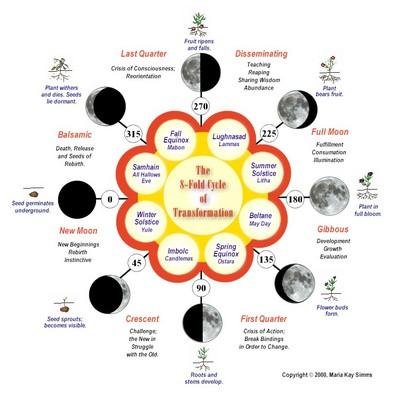
Wheel of the Year


YULE
December 21 - Winter Solstice, December 20-23; varies according to the particular date on the standard calendar according to when the Solstice will occur astronomically.

In the story of the Goddess and the God that is reflected in the solar year, we celebrate the birth of the God as Oak King to the Mother aspect of the Goddess on Winter Solstice (or Yule, approximately December 21st). Because the God is also associated with the Oak tree, the moon falling closest to the Winter Solstice is often called The Oak Moon and is the first moon of the year. As we celebrate the new year, many of us think of the elderly "old year" being replaced by the child "new year." The dualistic God experiences the Holly King dying of old age (the old year passing) even as the Oak King is reborn (the new year arriving). This reminds us once again of the sacred cycle of life, death, and rebirth.

The Winter Solstice is a solar occurrence which the Pagans recognize as a spiritual celebration. In scientific terms, this Solstice occurs when the Earth's swinging as it orbits the Sun puts the Northern Hemisphere farthest from the Sun. At this point, the Earth begins to swing back. The Solstice is experienced on the Earth's Northern Hemisphere as the longest night of the year; the turning point when nights begin to shorten and days to grow longer. (The Southern Hemisphere experiences the same effect, but at the opposite point on the calendar. This is why Australian Christians celebrate Christmas during the hottest time of their year.) The Winter Solstice marks the return of the Sun's warmth and light, and the promise once again of a productive Earth. Pagans celebrate these aspects with candles, fire, and greenery. In the Sacred Marriage story cycle, this is the time when the Goddess births the new God, representing the return of the Sun.

Also called: Jul, Saturnalia, Christmas, solar/secular New Year
Dates: around December 21
Colors: red, green, white
Tools: mistletoe, evergreen wreath, lights, gifts, holly, Yule log, Yule tree
Energy: regeneration & renewal
Goddesses: Great Mother, Isis, Mary, Tonazin, Lucina, Bona Dea
Gods: Sun Child, Horus, Jesus, Mithras, Santa/Odin, Saturn, Holly King
Rituals: personal renewal, world peace, honoring family & friends
Customs: wreaths, lights, gift-giving, singing, feasting, resolutions

IMBOLC
February 2 Candlemas, Brigid's Day.

As with so much in our lives, Imbolc (February 2nd) is a time of promise and expectation. And waiting. The Goddess is still embracing the aspect of Mother, pregnant with the God of the waning year (the Holly King) who will be born at Ostara.

But the unborn god-child in the Goddess's womb isn't the only life beginning to stir. At Imbolc we honor the lengthening of days and, with the increasing sunlight, we honor the stirring of vegetative life in the world. Though it is only February 2nd, warm weather is just around the corner. And although the promise and potential are there, we still have the reminder of winter's darkness to make it through.

Imbolc is the time of the beginning of beginnings, the time to consider carefully what you will do with the year stretching before you. It is the point in the cycle of the year when the returning light can be seen upon the land as the days lengthen. Though the Earth is still cold from winter, the lambs are born now along with the promise of returning spring. The ice begins to melt and the springs flow again. Pagans celebrate this Sabbat with candles and lights, and by honoring springs, wells, and running waters with flowers and song. Celtic Pagans tell of Bride (Breed), the Goddess who lives deep underground during the winter and stirs now to emerge with the water. Where she walks, flowers grow in her footsteps and lambs play in her path. In the Sacred Marriage story cycle, this is the time when the Goddess as Mother brings the infant Sun back to the Earth. The period between Yule and Imbolc contains all three aspects of the Goddess -- the Mother giving birth, the Crone serving as midwife, and the Maiden bringing new life to the Earth.

Also called: Candlemas, Oimelc, Brigid's Day; merged with Lupercalia/Valentines Day, Feast of Pan, Feast of Torches
Dates: February 2, early February
Colors: white, red
Tools: candles, seeds, Brigid wheel, milk
Energy: conception, initiation, inspiration
Goddesses: Brigid, Maiden
Gods: Groundhog, other creatures emerging from hibernation; young Sun
Rituals: creative inspiration, purification, initiation, candle work, house & temple blessings
Customs: lighting candles, seeking omens of Spring, cleaning house, welcoming Brigid

OESTARA
March 21 - Eostar, Spring Equinox, March 20-23 dependent on actual astronomical event.

In the story of the Goddess and the God, the Holly King (the God of the waning year) is born at Ostara (the Spring Equinox). Just as life is always around us, we are reminded through the birth of the Holly King that death is also a natural part of things. Death is neither good nor bad, but an integral part of the life/death/rebirth cycle.

The Equinoxes are the balancing points in the cycle of the seasons, reminding us of the harmony of the whole. They occur in Spring and Autumn when the day and night are of equal length. Oestara represents the bringing forth of new life, which will be nurtured during the coming Summer. Buds of flowers and leaf, all manner of eggs and just-born life are celebrated in decorations and imagery as Pagans rejoice in the Earth's reawakening. This is the fulfillment of the promise of Spring, the faith in the sacred cycle of life-death-rebirth, which sustains us throughout the dark cold of Winter. In the Sacred Marriage story cycle, this is the time of the young God coming into his power and the Goddess, fully recovered from giving birth, returning to her Maiden aspect.

Also called: St. Patrick's Day, Easter
Dates: around March 21
Colors: green, yellow
Tools: eggs, basket, green clothes
Energy: birthing, sprouting, greening
Goddesses: Ostara, Kore, Maiden
Gods: Hare, Green Man
Rituals: breakthrough, new growth, new projects, seed blessings
Customs: wearing green, egg games, new clothes, egg baskets

BELTANE
May 1 - May Eve, April 30th-May 1st.

Beltane is the great Fertility rite of life, starting at dusk on the 30th and continuing until the dawn of the 1st. The union of the God and Goddess to conceive the sun-child to be takes place upon this holiday, no matter which tradition of paganism is involved. Beltane is the one holiday most discouraged by the Christians, who didn't even use it as a point for a holiday of their own because the power and nature of the day involved. Still, even in Christianized Ireland the May day dance of the Maypole remained, as did the giving of flowers to those you loved or cared for as friends. The Maypole is a symbol of the union of the God and Goddess to create life, the pole itself a phallic symbol while the dancers and their streamers or vines of flowers represent the fertile womb of the goddess as it takes in the Phallus of the god and takes in his seed. Besides the Maypole often a bonfire is present, and members of the group are encouraged to jump the flames for luck and their own fertility. Food, drink and love are the order of the evening. In most sects the celebration of unions of love are enacted. Beltane is the time of many marriages/handfastings in the pagan community (in some it is the point where one chooses to begin and end relationships of a physical nature). Beltane is a celebration of fertility and pleasure. In the story of the Goddess and the God, the Oak King and the Maiden aspect of the Goddess become lovers, and are joined in sacred union. The Goddess becomes pregnant with the child that will be born at the following Yule; the Oak King reborn.

Beltane is a "cross-quarter" day, marking the point between the solstice and the equinox. New growth spurts forth, fruits begin to form, and grain grows tall in preparation to set seed with the Summer's warmth. With the warming of the Earth and the renewal of her fertility, the Goddess begins her transformation from Maiden to Mother. Beltane was celebrated in agrarian cultures with the fertility symbol of the maypole and by the "crowning" of the May Queen. Pagans today still weave crowns of flowers, and dance and wind ribbons around a pole topped with a wreath of flowers. In the Sacred Marriage story cycle, this is the time of the Goddess and God coming together as equals to consummate the Sacred Marriage, so that the Goddess may bring forth the new God at Yule.

Also called: May Eve, May Day, Walspurgis Night
Dates: April 30, early May
Colors: rainbow spectrum, blue, green, pastels, all colors
Tools: Maypole & ribbons, flower crowns, fires, bowers, fields
Energy: youthful play, exhuberance, sensuality, pleasure
Goddesses: May Queen, Flora
Gods: May King, Jack in the Green
Rituals: love, romance, fertility, crop blessings, creativity endeavors
Customs: dancing Maypole, jumping fire, mating, flower baskets

LITHA
June 21 - Midsummer, Summer Solstice, June 20-23, dependent on actual astronomical event

Held on the longest day of the year, the Solstice is the celebration of light's triumph over darkness and that of the bountiful beauty that light brings into life. Flowers are common in the circle, roses and bright cheerful wildflowers are upon the altar and usually worn by all. It is the changing point of the year, and the celebration of the spiral dance of the year is common among Wiccans. It a celebration with much joy, and much feasting. After months of growing sunlight, the sun has reached its peak Midsummer (Summer Solstice). In the mystical story of the Goddess and the God, the Oak King is confronted by his shadow self, the Holly King, and the God of the waxing year is slain. With each passing day, the hours of sunlight will grow less. Even though the crops that were planted will continue to grow, even though we will still experience warm weather and summertime fun, there is a definite change in the world around us. Ever so slowly, the year is beginning to fade. In the past, bonfires were leapt to encourage fertility, purification, health and love. Midsummer is a classic time for magick of all kinds.

The Summer Solstice is a solar occurrence, recognized by Pagans as a spiritual celebration, when our tilted Earth places the Northern Hemisphere closest to the Sun. It marks the Sun's maximum height in the sky, providing the longest day and shortest night of the year. We pause at this center of the year, balanced between what was and what will be, readying ourselves to leap forward with the Earth into the fecundity and fruitfulness of the growing season. Pagans celebrate with light and warmth of this time; in the past this was often marked with bonfires and celebrants staying awake through the short night. To leap over the bonfire was to assure a good crop; some said the grain would grow as tall as the leapers could jump. In the Sacred Marriage story cycle, this was a time of ascendancy of the God, at his most powerful now, while the burgeoning Goddess brought forth the bounty of the Earth.

Also called: Midsummer, Litha, St. John's Day
Dates: around June 21
Colors: yellow, gold, rainbow colors
Tools: bonfires, Sun wheel, Earth circles of stone energy: partnership
Goddesses: Mother Earth, Mother Nature
Gods: Father Sun/Sky, Oak King
Rituals: community, career, relationships, Nature Spirit communion, planetary wellness
Customs: bonfires, processions, all night vigil, singing, feasting, celebrating with others

LUGHNASSADH
August 1

In Celtic realms this is the celebration of the wheat god. Lugnasadh is many things. It is a celebration of the first fruits of the harvest. And as such, we have a wake for the Oak King. The year is in the Holly King's hands, and we celebrate that fact even as the God and the Goddess make love and she becomes pregnant with the child that will be born the following Ostara. Much feasting and dancing occur, though it is a bit more somber than many of the other holidays. Some Pagans celebrate this day as mearly the day to bake their bread and cakes for the coming winter and do no actual rituals save that of blessing the foods prepared. Pagans see this as a time when the God loses his strength as the Sun rises farther south each day and the nights grow longer. The Goddess watches in sorrow and joy as she realizes the the God is dying yet lives on inside her as her child. As summer passes, Wiccans remember its warmth and bounty in the food we eat.

Lammas is the "cross-quarter" day marking the first harvest of early grain, the "first fruits" of the year. With the harvest, the grain that is cut both nourishes the living and provides the seed that will be planted to nourish us next year, completing the cycle once again. A common Pagan ritual of this time is eating bread made from the first-harvest grain and drinking new wine. It is also a time to honor the Goddess as Demeter, who personifies the bountiful harvest. Stalks of grain, harvesting tools, and breads decorate the altar. Sometimes people make "corn dollys," small decorated figures from cornhusks, to be burned at the next Lammas celebration, symbolizing the sacrifice of the grain. In the Sacred Marriage story cycle, this is the time when the God, associated with the crops, is voluntarily sacrificed. The Goddess, as Crone, presides over this sacrifice. As His blood flows into the Earth, the land and the Goddess are made fertile. Thus, by His death, the God's rebirth is assured.

Also called: Lughnassad
Dates: August 2, early August
Colors: orange, yellow, brown, green
Tools: sacred loaf of bread, harvested herbs, bonfires
Energy: fruitfulness, reaping prosperity
Goddesses: Demeter, Ceres, Corn Mother
Gods: Grain God, Lugh, John Barleycorn
Rituals: prosperity, generosity, continued success
Customs: offering of first fruits/grains, games, country fairs

MABON
September 21 - Fall Equinox, Sept. 20-23, dependent on actual astronomical event.

Mabon (Autumnal Equinox) is a celebration of harvest, a time to reflect on the successes we've had in the fading year, those chapters of our lives that are coming to a close. We celebrate both the abundance of the earth, as well as the abundance in our lives, giving thanks for what we have received during the Wheel of the Year as the Oak King begins to make his descent into the underworld. The autumn equinox is the completion of the harvest begun at Lammas. Once again the day and night are equal as the God prepares to leave the body and the begin the great adventure into the unseen, toward renewal and rebirth of the Goddess.

Mabon is the high harvest, when the produce of the year, the fruits, vegetables, and grains, are brought from the ground and laid away for the coming dark time of winter. Pagans celebrate this as a rite of Thanksgiving, a celebration of harvest abundance, an appreciation of hearth, home, and family. It is balancing point in the light and dark of the year, the day when the sun has equal hours in and out of the sky. Altars are decorated with all the bounty of the harvest, and with Autumn leaves. Apples are shown sliced crosswise, to reveal a hidden pentacle of seeds. The fallen leaves remind us that the active time of the year is almost over and soon the Earth will begin Her sleep, to waken refreshed in the Spring. In the Sacred Marriage story cycle, this is the time when the Goddess carries within Her the sleeping God, who will come forth again at Yule.

Also called: Mabon, Michaelmas
Dates: around September 21
Colors: orange, red, brown, purple, blue
Tools: cornucopia, corn, harvested crops
Energy: appreciation & harvest
Goddesses: Bona Dea, Land Mother
Gods: Mabon, Sky Father
Rituals: thanksgiving, harvest, introspection
Customs: offerings to land, preparing for cold weather, bringing in harvest

SAMHAIN
October 31
At Samhain, the Wicca say farewell to the God even though he readies to be reborn at Yule. This grand sabbat, also known as Feast of the Dead ,Feast of Apples, All Hallows, and of course Halloween, once marked the time of sacrifice. This was the time when animals were slaughtered to ensure food throughout the winter. The gates of the underworld open to accept the Oak King on Samhain (October 31st). In many traditions, this was the time of year that all spirits entered the afterlife. A time to say a final goodbye to family members and friends that have died during the previous year, as well as a time to give thanks to the animal world for the meat that some witches still eat. It is a time of endings of relationships and bad situations and it is the time when one can see the glimmer of hope in the future. Truly a time of remembrance of our ancestors and all those who have gone before.

The Pagan year began (and ends) with Samhain (sow'-an), also known as Halloween. This is the time when the boundary is thinnest between the worlds of living and dead. It is a time to honor those who have gone before us, and to acknowledge that the Earth, and we on the Earth, are entering the darkest time of the year. From now until Yule the nights continue to grow longer, and the days colder, as the Earth enters her annual slumber, resting after the exhausting production of the summer and fall. In past times, when people lived closest to the land, this was the time when people evaluated their harvest and the number of stock and people that could be supported through the winter. Excess livestock was slaughtered and the meat put by for the winter. Pagans celebrate Samhain as an acknowledgment that without death, there can be no rebirth. In the Sacred Marriage story cycle, this is the time when the God dies and the Goddess sleeps, pregnant with the new God.

Also called: Halloween, All Hallows Eve, All Saints & All Souls, Day of the Dead
Dates: October 31, early November
Colors: black, orange, indigo
Tools: votive candles, magic mirror, cauldron, pumpkins, divination tools
Energy: death & transformation; Wiccan new year
Goddesses: Crone, Hecate
Gods: Horned Hunter, Cernnunos, Anubis
Rituals: honoring ancestors, releasing old, foreseeing future, understanding death and rebirth
Customs: jack o'lanterns, spirit plate, ancestor altar, divination, costumes

Thanks to Graelan Wintertide for this wonderful thorough explication of the wheel.

A True Account Of Talking To The Sun At Fire Island

a

The Sun woke me this morning loud
and clear, saying "Hey! I've been
trying to wake you up for fifteen
minutes. Don't be so rude, you are
only the second poet I've ever chosen
to speak to personally
so why
aren't you more attentive? If I could
burn you through the window I would
to wake you up. I can't hang around
here all day."
"Sorry, Sun, I stayed
up late last night talking to Hal."

"When I woke up Mayakovsky he was
a lot more prompt" the Sun said
petulantly. "Most people are up
already waiting to see if I'm going
to put in an appearance."
I tried
to apologize "I missed you yesterday."
"That's better" he said. "I didn't
know you'd come out." "You may be wondering why I've come so close?"
"Yes" I said beginning to feel hot
and wondering if maybe he wasn't
burning me
anyway.
"Frankly I wanted to tell you
I like your poetry. I see a lot
on my rounds and you're okay. You
may
not be the greatest thing on earth, but
you're different. Now, I've heard some
say you're crazy, they being excessively
calm themselves to my mind, and other
crazy poets think that you're a boring
reactionary. Not me.
Just keep on
like I do and pay no attention. You'll
find that some people always will
complain about the atmosphere,
either too hot
or too cold too bright or too dark, days
too short or too long.
If you don't appear
at all one day they think you're lazy
or dead. Just keep right on, I like it.

And don't worry about your lineage
poetic or natural. The Sun shines on
the jungle, you know, on the tundra
the sea, the ghetto. Wherever you
were
I knew it and saw you moving. I was
waiting
for you to get to work.

And now that you
are making your own days, so to
speak,
even if no one reads you but me
you won't be depressed. Not
everyone can look up, even at me. It
hurts their eyes."
"Oh Sun, I'm so grateful to you!"

"Thanks and remember I'm watching.
It's
easier for me to speak to you out
here. I don't have to slide down
between buildings to get your ear.
I know you love Manhattan, but
you ought to look up more often.
And
always embrace things, people earth
sky stars, as I do, freely and with
the appropriate sense of space. That
is your inclination, known in the
heavens
and you should follow it to hell, if
necessary, which I doubt.
Maybe we'll
speak again in Africa, of which I too
am specially fond. Go back to sleep
now
Frank, and I may leave a tiny poem
in that brain of yours as my farewell."

"Sun, don't go!" I was awake
at last. "No, go I must, they're calling
me."
"Who are they?"
Rising he said "Some
day you'll know. They're calling to you
too." Darkly he rose, and then I slept.

-------------------------------------------
Frank O'Hara (1926 - 1966)


Francis Russell (Frank) O'Hara (June 27, 1926 - July 25, 1966) was a United States poet who, along with writers like John Ashbery and Kenneth Koch, was a key member of what was known as the New York School.

Frank O'Hara, the son of Russell Joseph O'Hara and Katherine Broderick, was born in Baltimore, grew up in Massachusetts and moved to New York City in 1951.

His work was immediate and were often quickly typed out. (One collection, Lunch Poems was so named because he typed them up on his lunch hour.) Low and high cultural references mingle easily in his work, with an often dreamlike lyricism. His most anthologized poems are "Why I Am Not a Painter" and "The Day Lady Died," the latter about Billie Holiday.

O'Hara was active in the art world, working as a reviewer for Art News and as a curator for the Museum of Modern Art. He was friends with a number of prominent artists like Willem de Kooning, Larry Rivers and Bill Berkson.

O'Hara died in a freak accident on Fire Island. He was run over by a dune buggy while sleeping on the beach.